
A Few Random Thoughts About Trees for Arbor Day and Spring

There’s something about trees that makes me feel good without thinking. I might believe I’m as low as the soles of my shoes, worrying about car payments, anxious over diplomatic relations with North Korea, fuming about my flopped soufflé, but let me walk by a spruce, aspen, maple or oak, and that mood starts to dissipate. The day seems sunnier, the air, fresher.
Doesn’t matter the season. Every season brings its own joys and discoveries. Last winter a frost would hit, and leafless trees would be iced with the most delicate coating of crystals. In spring tiny green buds push through the protective scales as if sampling the climate to decide if the temperature warrants further growth. Trees seem to pulse with life itself.

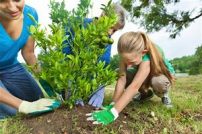
Arbor Day is coming up, the last Friday in April in most states. I remember planting a sapling with great ceremony with my class in elementary school, as well as sporadic similar activities over the years hosted by community groups. Why did we bother? When with typical human irrationality, for centuries we’ve cut down and decimated trees by the millions. England, Scotland, and Ireland used to be covered with forests, but mankind happily thwacked its way down to the earth to use the resources for more urgent needs.

Now Arbor Day, as well as additional activities like the Tree City USA program, are trying to make amends by encouraging natural tree and plant life in this country. However, this is not a global trend. A report from the Food and Agriculture Organization of the United Nations says the single largest source of greenhouse gas emissions in Latin America and the Caribbean is the conversion of forests to other land uses, such as agriculture. In Brazil alone, 78 million acres of rainforest are lost every year! More than 20 percent of the Amazon rainforest is already gone. Perhaps they need a huge horde of elementary school students swarming into the region to plant seedlings.

Unfortunately, do-gooders’ enthusiasm may outstrip scientific knowledge. Planting the wrong type of tree may do more harm than good if we’re discussing global warming. The New York Times reports using conifers where broad-leafed once flourished might increase global warming, while in colder regions, trees absorb more sun heat, again raising ground temperature.

We can’t win, at least until we learn there are no simple answers to complex problems, no matter what the issue. Until we can figure out the solutions for the dilemma of trees and global warming, we can treasure the trees currently in our lives. Parks, thoroughfares, pots, farms, mountains, forests–trees are everywhere. Let’s take note by celebrating the low-key, simple, friendly observance that’s Arbor Day.


 

A COVER NOW REVEALED

ANNOUNCING MY NEW BOOK, NEVER RETREAT, TO BE PUBLISHED IN MARCH 2018, BY Imajin Books.  A feisty single mom clashes with an ex-military, macho corporate star at a business retreat in the wild Colorado mountains, where only one can win a huge prize. But when a massive flood imperils their love and survival, they learn the meaning of true partnership.

I’ll be organizing some give-aways as well as the opportunity to receive a e-copy for those interested in preparing reader reviews for online sites. Contact me at Bonnie@BonnieMcCune.com if you’re interested.

Rocky Mountain High at an Advanced Age: a short and successful journey to pot use

I’ve been an anti-drug advocate for eons. It’s probably because I feel my grip on reality is so tenuous, if I started using, I’d be dependent. I also have seen the impact of drug abuse on friends and relatives, even worse the tangled, chaotic, destructive pain they dump on their supposed loved-ones.

Yet count me in the ones who advocate de-criminalizing the stuff. It’s proven we’ve lost the War Against Drugs, and these efforts don’t make a dent in drug use.  Their impact—ruining lots of lives with long prison sentences, raising taxes, splitting families.

This stance opened the door and my eyes to the use of marijuana. As campaigns to legalize the stuff spread, I began to learn about people who have been helped by their use—health concerns such as arthritis, epilepsy, cancer treatments.. I heard the scare tactics from decades ago, which created my intense paranoia about negative impacts, were very much blown out of proportion. Then my home state legalized use several years ago.

In what might be considered serendipity, I was suffering from an autoimmune condition  that affected my legs. Discomfort, itchiness, restlessness kept me awake at night. My search for relief brought me to seven or nine kinds of skin creams and lotions, various over-the-counter pills, and sleep techniques, none of which really helped. During lunch with a friend, she mentioned she suffered from arthritis in her knees. Since she’s an avid hiker, she’d also been chasing a treatment that would enable her to continue her exercise. Turned out to be a marijuana cream and patches.

She accompanied me to a marijuana dispensary and helped me through my first meeting with a salesman. In a candid interchange, she told me what helped her and what I might consider. I walked out with a salve which turned out to relieve my aches and pains. Every person is different, and some aren’t helped. The treatment doesn’t cure me, isn’t uniformly effective, but does more than anything else has.

After my little sampling of this psychoactive drug, I’m most pleased to find that I’m capable of changing my mind. Many people, me included, feel the older you get, the more rigid you are. How you are at about 30 pretty much sets the pattern for the rest of your life, except you get more inflexible in your opinions. Not a good position to be in, for we all should be able to face new situations, learn new information, and adapt for our own benefit.

This is one old dog who’s learned a new trick.


Why the internet may just be what saves humanity

There are many things I despise about the internet: the addiction to its use that seems to be spreading like a virus; the disregard of writing and editing standards in its content*, the lowest common denominator tenor of most messages, which cater to puerile, malevolent gossip; its reliance on mass popularity to evaluate worth and value; its emphasis on the herd perspective.

Yet the internet is the great leveler, which can be good. Accessible worldwide, even under despotic governments with enough planning, wriggling, and techie knowledge, people are figuring out how to connect with others.  Yes, a number of governments censor use and content, but they’re in roughly the same situation as the little Dutch boy trying to hold back the ocean at the dike. Smart phones leapfrog the purchase of expensive computers, plus they spread real-time images nearly instantaneously. News circulates in the same fashion, and the emotional temperature of a group be captured and distributed to observers around the globe.

Of course there’s the potential for hideous abuses, given the lynch mob mentality that can hold sway. The very rapidity of communications eliminates that period in which thought can amend activity. Arguments extend indefinitely with more strength than face-to-face encounters.

But there are benefits, too. Still since the 2016 national election, the internet has become a source of solace to me. I had real fears that our country had embarked on a period of political suppression and confusion, in which every belief I held dear was to be ignored, even violated. But as the weeks and months passed, people made their contradictory and outspoken voices heard. For every claim, there has been a counterclaim. The confusion remains, but if you’re determined, you can uncover facts, rational discussions, pros and cons on issues, topical developments in news and development.

This hasn’t happened before. Think of Armenian genocide in Turkey and Hitler’s Kristallnacht. If the internet had existed, perhaps more people would have responded to save Armenians or anticipated the Nazi horrors.

Or perhaps not. Starvation, internecine violence, persecution of ethnic groups, and other major issues still surface, indeed, appear to be proliferating. Still, they can’t be hidden any longer. People can reach out to inform one another,organize for improvement and change.

if we could just get people to use rational thought and good will to evaluate their actions before they take steps, we just might be on the path to improve human life as well as preserve the planet.

*People ignore the real need that rules of grammar fill to insure a reader’s comprehension. Yes, they’re arbitrary and nonsensical. But they also provide an agreement on the use of language, so you can tell what the speaker or writer means. Failure to comply not only leads to misunderstandings but also indicates a lack of education in the user. On an official website for a woman’s magazine, I recently read a person described as a “business magnet” rather than a “business magnate,” quite a difference. If a magazine written, edited and produced by professionals can’t maintain clear writing, why should I buy the publication?

Do you have holes in your head, holes in your jeans, holes in your head AND your jeans?

jeansWith the exception of a brief period of time from age 15 to 24, I’ve never been a fashionista. During my teens and post-adolescence, finding my way among my peers, my attention to fashion seemed mandatory since it occupied a great deal of attention from my friends. Thereafter I focused on family and career, believing that style failed to hold the importance of those other areas.

I don’t belittle women who waste lots of time shopping, reading fashion magazines, and thinking about style. That’s their choice.

But one fad irritates me no end. I find it patronizing and ridiculous. That’s the decision to wear jeans with holes in them. Most frequently in the knee area, but also across thighs, calves, even buns, some with a combination of all three, and a greater or lesser amount of exposure. Usually called “distressed” or “ripped,” you purchase these already hole-y or you buy new ones and cut, tear and wear into the pattern of your choice. They’re usually worn with $400 high heels, leather jackets, and $75 manicures and pedicures.

There’s the rub. Believe it or not, there are people in this country and this world who can’t afford new clothing. They wear pants with rips, holes, and patches, not with self-satisfaction and preening, but with numb acceptance. Perhaps there are some who dress with pride in rags because they are triumphing over their circumstances. They know the importance of NOT defining themselves by the cost or condition of their garments.

Distressed pants coopt, embrace qualities like rebelliousness, individualism, populism. In the 60s and 70s, counter-culturists wore distressed jeans to recycle useable materials, to protest a consumerist materialistic culture, or to express their creativity through embroidery and artistic patches.

Most women wearing ripped jeans now have no idea what their appearance advocates. As they step adroitly out of the way of a homeless bag lady asking for a handout, as they toss money in a high-end store to purchase a piece of clothing that could feed a family in poverty for a week, they make a mockery of the realities of life for the poor. They insult people too broke to buy decent attire. My 12 year old niece might be excused because she’s still trying on personalities and interests. An adult woman? Not so much.

Are they a fashion or a fad? Fashion lasts longer and tends to emulate “prestige groups,” although some commentators see the process as a mutual exchange. Fads come and go quickly and tend not to originate in the elite. They’re ephemeral and follow the pattern of a craze, first exciting and capturing notice, spreading quickly, finally fading into nothingness.

In the case of distressed pants, a slap in the face of every needy individual in the world, we can only hope. You’re not fooling a soul. You’re neither fashionable nor socialist.