
Do We Live in a Perfect World?

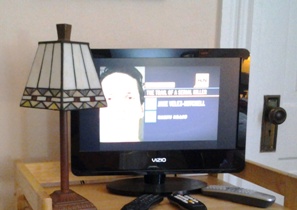
tv set small

Seems like we do according to the news on the local major TV stations.  I accidentally was watching one evening recently while the broadcast was on.  I heard something about the weather and a car accident, sports and a murder.  These items were cushioned by jokes among the newscasters, snippets about entertainment and movie stars.  There was an alert suggesting that the viewers’ vote on the next Food Network Star and a serious report about the search for proof on Big Foot.

While this was a Colorado broadcast, not national, not a word passed related to the economy, education, social issues, arts, health concerns, or politics.  Evidently we’ve solved all problems since nothing was mentioned.  Or people interested in more substantive reporting must not watch television. 

Both national and local news operations are facing declining viewership and revenues. (One point of view: http://www.nytimes.com/2013/05/13/business/media/tv-networks-face-falling-ratings-and-new-rivals.html?pagewanted=all&_r=0) There’s talk about slashing budgets, collaborating among personnel, closing operations. 

I used to avoid news because I didn’t want to get depressed and frustrated by the dismal conditions in the world.  My rule of thumb was, “If there’s nothing I can do to impact the situation, I don’t want to hear about it.”  Unfortunately, I have no one to blame but myself for the type of stories now covered by television news.  Or me and the other thousands who have given up caring about the state of the world and accompanying news exposure. 

But I don’t want to settle for pleasant, sometimes pretty, faces mouthing inanities and chitchat.  I’m better off spending the news hour scrubbing my kitchen cabinets and checking my bank statement. 

Guess I deserve a blank television screen at news time.  And with plummeting audiences, that’s just where we appear to be headed.

It’s Not Nice to Fool (Around With) Mother Nature, or Carl Hiassen’s Vindication

Sometimes it seems this world has lots of mean people—greedy, self-centered, and unthinking. They’re amassing money, ignoring real needs, and destroying the environment.

It’s even easier to find bad guys in Florida, at least according to author Carl Hiassen, who’s been beating on this drum for decades.  Usually categorized as a mystery writer, Hiassen is truly a social satiricist, attacking the profiteers, idiots and bad guys who value the all-mighty dollar at the cost of the natural world and common decency.

Many of his plot points seem impossible—rodents with tongues dyed blue, an Orange Bowl Queen kidnapped by a local terrorist cell, an evil developer so obsessed with Barbie he remakes his flings into doubles.

Lo and behold here comes real life to prove anything is possible, even Hiassen’s visions.  Recently a sinkhole near Disney World gobbled up a resort with no warning. Slowly, slowly the villas, elevator shaft and walkways cracked and shattered, then sank into the ground.  Fortunately all visitors and staff were evacuated with no injuries.

I have to wonder if Mother Nature is finally flexing her muscles to take revenge.  In Hiaasen’s books, humankind has so brutalized the native flora and fauna that any benevolent balance seems impossible.  Even the folks charged with creating and enforcing laws to protect, not only the environment but also people, gleefully ignore, cheat, and steal to cover their own assets and asses.

An official with the USGS said humans are accelerating the problem of “sinkhole alley.”  Development creates surfaces off which water must run off, then go underground to cut through weak rock and exacerbate the problem.

Is Hiaasen an extremist or a prophet?  An hysteric or a pragmatist?  We may be getting a response from Mother Nature.


Why Can’t We All Just Get Along?

Fort Robinson

Fort Robinson

I’ve never been able to understand why men indulge in fistfights. Seems to me at the conclusion you have bloody, damaged participants, and no one wins much of anything except a snippet of status. By extension I feel the same way about armed conflicts. Seems to me the people of both countries lose out and only the top dogs, be they generals or CEOs or presidents stand to gain. The rest of us are poorer, damaged, depressed, and older, but not wiser.
I've come to accept that aggression and violence must be part of the human condition. After all, look at stories and histories down the ages, right from the beginning, i.e., Cain slew Abel. Maybe we needed that brutal streak to guard or feed our families.
From this bias, I'd be unlikely to wax enthusiastic about a military facility, but here I am, touting Fort Robinson. Now a state park in Nebraska, it was an active post from 1874 (first as a camp, then with permanent buildings) until after WW II. These days, although many structures remain, together with a smattering of horses that remind visitors of the Fort’s equine prominence, it’s become a recreational area, perfect for families to run wild and those seeking a retreat from everyday busy, as well as a time capsule of Old West history.
As I peeked into the reproduced or renovated cabins and houses, saw where Chief Crazy Horse received his death blow from a bayonet in the back, imagined the thousands of dogs trained for military during WW II, and walked the paths of a German POW camp between now-vanished barracks, I was struck over and over by the similarities among all the people who’d lived here more than the hegemony* the US government exercised. The Indian women who managed to escape during the 1879 debacle with their children had much in common with the military wives who feared losing their husbands to violence and their children to illnesses. The German soldiers held to a routine almost identical to the Americans’.
Fort Robinson is the perfect place to ponder these questions. You can bed down in the old enlisted men’s quarters in simply furnished but immaculate rooms. Walks or rides or biking let you contemplate nature and just how tiny our struggles seem next to the wide Nebraska skies and variegated greens of grass, evergreens, and shrubs.
I wish I could have packed Fort Robinson’s time and space for musing to my everyday life.
* Hegemony: domination, preponderant influence, or authority over others.

Don’t It Make My Brown Eyes Green?

eye

Through chance, not planning, I have the great fortune right now of being able to escape an eight-to-five job.  With this flexibility, I’ve turned to writing fiction, which always has been my goal.  But the strangest thing happened.  The freer my time and more open my schedule, the less motivated and more depressed I became.  It got to the point I couldn’t answer the simple question “how are you?” and I avoided talking to friends and family.  No project seemed important enough to complete.  I dreamed up excuses to slump in a chair reading or click through television stations searching for something, anything, to fill my time.  

What was wrong?  Was my iron low?  Supplements didn’t help.  Did I have an undiagnosed mental malady?  I still cracked jokes left and right when I found myself in a group.  Was I just getting old and experiencing a decline?  I knew plenty of people my age and older who were still going strong. 

The answer, or at least an answer finally came to me at a meeting.  Every woman who spoke seemed to be traveling or working on an exciting project or changing the world for the better.  I was envious of every single person there.  This didn’t make sense, I thought.  I’d never felt this way before.  

That’s because I’d previously always been super-busy.  Held down a full-time job, wrote in my spare time, volunteered with several groups, went places with my husband, saw friends regularly.  But since my self-imposed isolation, I mostly had contact just with myself. 

No one, not even an independently wealthy super-introvert (which I’m not), can survive with no external stimulation.  We’re human beings, and we need interaction with others.  We require the give-and-take, the ebb-and-flow of life around us, or else we stagnate.  That’s what was happening.  I was stagnating.  As Bob Dylan wrote years ago, “He not busy being born is busy dying.”  

With that realization, I’ve begun reconnecting with old acquaintances, attending an occasional event I usually avoid, becoming involved with a group whose work I support.  I no longer forget what day it is because my calendar has a variety of engagements for me to keep.  And they’re not all dental or doctor appointments.  

Jealousy is supposed to be a green-eyed monster.  But in my case, envy sparked a major improvement in my life I might not have achieved otherwise.

Nosy Nelly Snoops With No Shame

The books that stick in my memory are those that have real people in real life situations, even if they’re fantasies or mysteries. They face problems, defeat them or are defeated by them, live, learn, change. I love immersing myself in their stories, and I laugh or cry with them. Years ago I rode the bus while reading A Tale of Two Cities, and tears streamed down my face when Sydney Carton faced the guillotine. I bonded instantly with a woman pouring over The Joy Luck Club while waiting for car repairs.

In other words, I’m a Nosy Nelly. This antiquated term means someone who’s so interested in other people’s business that she sticks her nose in everywhere. Since I don’t dare indulge myself by peeping in my neighbors’ windows, I restrict myself to books. Since my life has a finite limit and I’m not a time traveler, books let me make endless trips to fascinating eras and equally entrancing personalities. Since I’m not a millionaire, I don’t spend a penny on my voyages through books.

Visual artists enable their viewers to see things in a new way. They open their eyes. In the same manner, writers enable their readers to think about the world and life in new ways. They open their minds. So my cupidity* for knowing about the extraordinary lives of ordinary people brings me rewards in addition to entertainment. How could I learn how a soldier in Viet Nam dealt with the armed conflict except through The Things They Carried? Catch a glimpse of a future I hope we can avoid in The Hunger Games? Get a sense of an immigrant’s situation in London in the course of White Teeth?

I’m neither limited to a single lifetime nor restricted in any other way. That’s why I read.

*Cupidity: greed, strong desire