
A Kiss Is Still a Kiss

eBook reader with girl_360 The fundamental things apply, says the old song, “As Time Goes By.” And this seems to be true of book reading, too. A book is still a book, regardless of its shape or format. USA Today and various studies used in its articles are tracking book reading by electronic and hard-copy means. They say that owners of e-readers and tablets actually increase their book buying. Other trends are those to be expected: younger people use electronics more, and they tend to discuss their choices more on social media.

What does this mean for the book world at large? Predictions of the death of the book are waaay premature. The packaging of books is certainly changing. Marketing may be a bit harder because mass media like newspapers are devoting almost no space to books. But word of mouth, always the most important method to convey your excitement about a book, continues very strong, actually enhanced by social media.

How much can we believe reports like this? Seems like every study on the positive side has a matching study on the negative, like the one from the National Endowment for the Arts. While 54.5% of adult Americans say they read a book voluntarily in 2012, the percentage who read a work of literature went down from 50.2% in 2008 to 46.9%. As usual, women are far and above bigger readers than men.

My own theory is that the public has much more access to books and reading material nowadays than any time in history. In early centuries, many people were illiterate or close to it. Even as you approach contemporary times, reading wasn’t necessarily an activity for everyone. My maternal grandfather dropped out of school in the eighth grade to help support his family, and I’ll bet many people have ancestors who were in the same boat.

Despite hysterical predictions that reading is going to die out, people use these skills all the type, just electronically. Plus consider this—maybe too many people are reading. Maybe we should be restricting or discouraging access to books, since people seem to be picking up some hair-brained ideas from it. Perhaps we should aim for only 25% reading decent literature, if they’re the right 25%. Of course, those individuals should be only ones who agree with me.

Battle of Sexes Moves to Books

books The battle of the sexes is fun, challenging, and never-ending. A recent combatant, perhaps fighting with a bent lance or a broken sword, is David Gilmour, a Canadian author and professor at the University of Toronto, who refuses to teach women authors. Despite Alice Munroe’s Noble Prize for literature (http://tinyurl.com/l6cvavl) and the presence of talents like Margaret Atwood (www.margaretatwood.ca), he feels there’s a lack of excellence in the majority gender.

He said he “teach[es] only the best” writers, which does not include women. “I say I don’t love women writers enough to teach them, if you want women writers go down the hall. What I teach is guys. Serious heterosexual guys.”

As a writer and book lover, searching for excellence myself, I’ve spent my life, book open on my lap, desk, table, under or over the covers, entranced and entertained and educated by volumes of all types. I never distinguished between male and female authors, perhaps because I was assured repeatedly by teachers that English uses “he” and “everyone” as general terms for BOTH sexes in the collective. So if someone says, “Every great writer uses his talents,” I take this to include men and women.

When a child and teen I tended toward male writers because their work seemed more complex and interesting to me. As I grew older, I veered more and more toward women. The distinction I see now is that women writers seem to be somewhat more interested in character and internal, psychological growth, than many male writers.

I do admit I feel some questioning, some slight resentment when a male author has a strong, central female character. Just because book reviewers, publications, editors have a bias for male writers and provide much more attention to them than to women. Although most readers and book buyers are women, those in charge (still strongly male) emphasize men.

Gilmour continues to try to explain his remarks, saying they were tossed over his shoulder while conducting another conversation in French and they were meant “jokingly.” Gilmour has a new novel out called Extraordinary, and in his apology, Gilmour notes that the book’s protagonist is a woman, and he hopes his apology will help smooth over any hard feelings.

My theory, having heard a remark at any number of seminars and conferences recently, is that “there’s no such thing as bad publicity.” Certainly Gilmour must be sincere when he says you must teach what you love. But perhaps he and his publisher quickly realized his public profile is strengthened by the controversy. That women, like me, who have never heard of him, now will read his new novel, if simply out of curiosity.

Unfortunately for him, his book will have to go on the bottom of my list, which, at last count, included 13 titles by women and 12 by men, not counting the 24 stacked up on a table, again, fairly evenly divided by gender. Some are even collections or co-authored by women and men. Imagine that.

To see The Atlantic’s take on the discussion, go to http://tinyurl.com/n93jpf6
To see some of the original interview, go to Hazlitt online, http://tinyurl.com/nqak86r
To see a follow-up interview on the topic, go to National Post online, http://tinyurl.com/n7s7rtv

A Story Told

“To be a person is to have a story to tell.” —Isak Dinesen

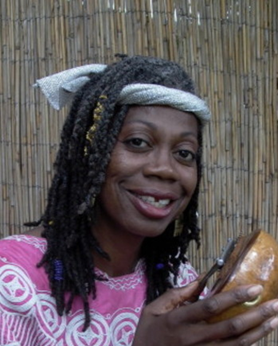
Opalanga Opalanga Pugh was an ordinary person with an extraordinary life, much of which she created and directed herself. Born in Denver, Colorado, in 1952, when people of color struggled against discrimination and limitations on their life choices, by 1972 she’d renamed herself after her Nigerian ancestors and begun her mission of storytelling.

Over six feet tall, chocolate brown, she carried herself like an empress. The gap between her front teeth, something that orthodontists would have wanted to correct, became a point of pride. In Africa the gap was associated with truth tellers.

That she was, but she couched the truth in stories, complemented by music and movement—from native peoples, from American culture, wherever a tale spoke to her. I once saw her speak to a group of some 75 women, mostly white and older. By the end of her presentation she was leading a line of all of us up and down the halls, around the rooms, in a joyous, joint celebration.

She said, “Who I am as a storyteller is one who is committed to the healing, the empowerment, and celebration of the human spirit. . .a Keeper of the Culture, a bridge-mother.” Known as a “griot,” a term and its variations used in West Africa for “storyteller,” she told her stories in ways that all peoples could understand and relate to.

She wasn’t with us long enough. She passed away in 2010 after a lengthy struggle, surrounded by close friends and family who had formed a network of support, provided day and night. Now those people have published, “When a Griot Dies,” a small book about her life, her journey, her spirit. Proceeds from its sale ($22 a copy) support the Opalanga Legacy Project, scholarships for all sorts of artists, keepers of the culture who honor her values.

“The universe is made of stories, not atoms.”—Muriel Rukeyser

For information on Opalanga, visit http://www.caringbridge.org/visit/opalanga
For information on “When a Griot Dies” or the Opalanga Legacy Project, contact Black Swan Books, opalangabooks@gmail.com ~ 303-366-4836

Good Job! No Problem!

Recently waiters, clerks, even folks holding an elevator door for me have burbled “No problem” in response to my request for help.  Puzzling because I’m not sure my request would be a problem even under the worst circumstances.  Why does my call for a glass of water, or inquiry if a dress comes in my size, or a gasped appeal for a short delay in an elevator ride result in this response rather than “yes” or “sure” or a British-like “certainly.”  

I’m not offended, simply curious how the phrase caught on. Its users are almost always under the age of 30 or 35; they frequently work in a service industry. Do they mean they’d let me know if they have a problem with my bidding?  I can’t imagine anyone responding, “No, that’s a problem” and slamming a door in my face or refusing to refill my coffee.  

I’m not the only person who’s noticed this.  A commentator on a national news show feels wait staff are substituting the term instead of saying “you’re welcome.”  I think its usage is broader; it also functions as general fill-in-the-blank verbiage and as a synonym for “I hear you.”  

Perhaps I should be grateful for this small sign of language adapting to new needs.  It confirms the vitality of English and its speakers.  But it brings me to another phrase I DO have a problem with—good job!  I first heard this maybe 15 years ago, used by a mother of three young boys on an airplane.  I was very impressed by her calm demeanor and positive words to the trio.  I’ve learned to use the phrase with my grandchildren, and it’s become so engrained, it’s automatic.  

I was drawn up short recently in a restaurant when my waiter used the phrase on me.  I’d eaten every scrap, and he lauded, “Good job!”  My response?  “Does it look like this body needed all that food?”  He laughed, but I began to wonder if (1) I look as simple-minded as a young child, or (2) if I use the term too much?  Some child-rearing specialists are pondering this point themselves.  “Good job” may be too obviously reinforcing the adult’s desired behavior. . .it doesn’t encourage the child to make decisions on his own. . .is too judgmental.  (See http://www.alfiekohn.org/parenting/gj.htm)  

Food for thought, and certainly no problem.

The Days That the Rains Came Down

Floods of near Biblical proportions. Hardly. But that’s been the description of Colorado’s weather this September as deluges, torrents, surges, and crests inundated what normally is semi-arid country. While “100-year flood” is a fairly common description, ours this year has been more like a 500-year level.

Have people been taken by surprise? Certainly those who build on or travel over flood plains shouldn’t be. Yet we don’t normally expect waters to mount so high out of their ordinary channels that they escape bounds and cover nearby acres. It’s easy to think, “Well, we should build more wisely.” But we simply can’t anticipate every contingency.

I kind of like that. I like knowing people aren’t omnipotent, despite our illusions to the contrary, that the natural world exists beyond our control, and we’d better remember that. Still for reasons unknown, the public complains. “The storm sewage system is inadequate.” “The schools should have water-tight basements.” “Why aren’t there broader shoulders on mountain roads to catch the slides?”

It might be that our world has so few real challenges that we need natural disasters. Humanity hits its highs and lows at these times. We always hear stories of heroism and tragedy. The media has something to spotlight other than a film star’s marriages or the stock market’s changes. We all have a chance to think “what if” and chatter about a near-miss we’ve had. Like this one: I was going to drive to a mountain town with several friends on the first day of the rains. The downpour didn’t look that heavy along our route. My wiser companion pointed out that our highway went through mountain areas with steep, rocky, and bare slopes, and mud- and rock-slides could be a problem. We cancelled the trip. Sure enough, whoosh!, slides hit the route we would have traveled.

We should realize we can’t prepare for every single potential disaster. If we go with the flow a little more, and enjoy challenges as they come along, appreciating our participation in and survival of nature’s vagaries, we might approach my two-year-old grandson’s attitude. When he spotted the flood in his basement, he ran for his swim suit, begging his mom to take him down to the “Pool! Pool!”