About Bonnie McCune

Bonnie is a Denver-based author whose interest in writing led to her career in nonprofits doing public and community relations and marketing. She’s worked for libraries, directed a small arts organization and managed Denver's beautification program. Simultaneously, she’s been a free lance writer with publications in local, regional, and specialty publications for news and features. Her main interest now is fiction writing, and her pieces have won several awards.

What’s So Funny? I’m Not Laughing.

I love to laugh, and I felt vindicated about the immense number of notions that tickled my fancy when studies started showing that laughing improves your health. Some situations deserve a belly laugh, like the time in a restaurant my husband accidently squirted me with mustard when he tried to force a recalcitrant dispenser that wouldn’t budge. Others rate a giggle, like a kid nibbling the bottom of his ice cream cone simply to sample from that end.
My two-year-old grandson finds nearly everything funny: crawling under a table, his grandpa’s twisty faces, even falling on his own head. And everyone around him has to laugh with him because he enjoys chortling so much.
But some things simply aren’t funny. I listen to radio station Comedy 103.1 in Denver, which features recordings of many comedians, most of whom I like. Occasionally I turn one off because he’s just not funny.
Why not? Because the jokes these comedians use are hurtful. They’re often pot shots at people who can’t fight back. One comic made fun of “little people;” another, of “intellectually challenged.” Whether you agree with this type of label or not, the humor can legitimately be directed toward label-makers; but shouldn’t be at the people with these conditions.
The non-funny schtick continues with attacks disguised as humor concerning people trying to get through life the best they can. Maybe an administrative assistant who can’t figure out the latest software program. Young victims of bullying somehow asking for their treatment. Famous people portrayed in an unfairly negative way (i.e., calling Paris Hilton “dense”). I can’t help putting myself smack in the position of these people and wondering how painful the comments must be to them.
I guess that’s why I prefer humor that a comedian directs toward himself or even his family. Even routines that puncture over-inflated egos of the rich and famous based on their real flaws, not characteristics or stuations they have no control over.
Books are different. They offer distance and analysis Even here, humor is a matter of opinon. I read a collection of short stories recently that were touted as humorous and hilarious. The Fun Parts, by Sam Lipsyte features stories that show the author’s unique perspective on off-beat characters rooted in hippy-dom, higher education fanatics, and a dollop of drugginess. I hardly cracked a grin because I found them sad and sensitive. Rather than side-splitting humor, Lipsyte really pays attention to what is tragic in life, and he gives no quarter for human weakness. A challenge to read, but worth the time.

Do We Live in a Perfect World?

tv set small

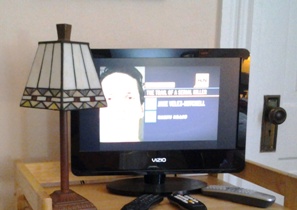
Seems like we do according to the news on the local major TV stations.  I accidentally was watching one evening recently while the broadcast was on.  I heard something about the weather and a car accident, sports and a murder.  These items were cushioned by jokes among the newscasters, snippets about entertainment and movie stars.  There was an alert suggesting that the viewers’ vote on the next Food Network Star and a serious report about the search for proof on Big Foot.

While this was a Colorado broadcast, not national, not a word passed related to the economy, education, social issues, arts, health concerns, or politics.  Evidently we’ve solved all problems since nothing was mentioned.  Or people interested in more substantive reporting must not watch television. 

Both national and local news operations are facing declining viewership and revenues. (One point of view: http://www.nytimes.com/2013/05/13/business/media/tv-networks-face-falling-ratings-and-new-rivals.html?pagewanted=all&_r=0) There’s talk about slashing budgets, collaborating among personnel, closing operations. 

I used to avoid news because I didn’t want to get depressed and frustrated by the dismal conditions in the world.  My rule of thumb was, “If there’s nothing I can do to impact the situation, I don’t want to hear about it.”  Unfortunately, I have no one to blame but myself for the type of stories now covered by television news.  Or me and the other thousands who have given up caring about the state of the world and accompanying news exposure. 

But I don’t want to settle for pleasant, sometimes pretty, faces mouthing inanities and chitchat.  I’m better off spending the news hour scrubbing my kitchen cabinets and checking my bank statement. 

Guess I deserve a blank television screen at news time.  And with plummeting audiences, that’s just where we appear to be headed.

Do Clothes Make the Man (Woman)?

Tee shirt webI used to think that clothes weren’t important. Labels meant nothing to me, and I prided myself on this attitude. I was superior to physical distinctions of wealth or status.

I’ve changed my mind gradually over the years. Clothes provide cues and clues to their wearer’s interests, education level, age, and social groups. This is important to writers because we have to be able to evoke all kinds of messages through people’s dress in our work. It’s also important to humans in general because it can be used, for better or worse, to categorize people and give us advance warning about how to respond to them.

But I still figured I was exempt from bias based on attire. Until I went to the doctor’s a few days ago. I was finishing up my appointment when a woman stepped into the exam room. My doc had mentioned consulting with another physician. But when I saw the newcomer, I was flabbergasted. Leaving aside the question of what a “flabber” is and how you “gast” it, I was taken aback because she wore jeans, tennis shoes, and a casual t-shirt.

Immediately I became uncomfortable. I couldn’t tell if she was a health care provider (Nurse? Doctor? Physician’s assistant?), or someone who’d wandered into the facility from the very urban streets nearby. Should I greet her? Duck behind the door? Scream for help? No clues about her job or level of responsibility. Did she report to my doctor or vice versa?

After my doctor asked the woman to locate some equipment, I realized she must be some sort of assistant. But I still was uneasy. I began to realize that how others dress has a major impact on me, and her lack of any professional signals established an initial level of distrust that she’d have to work hard to overcome. Her appearance obfuscated* her role.

I’m trying to take this knowledge as an insight into human behavior. I want to guard against, compensate for, this instantaneous prejudice when I meet strangers. But mostly what I want to do is alert my doctor and the assistant that she should dress in a manner to make patients comfortable, not ill at ease.

*obfuscate: render incomprehensible

Fit and Fitter

I’ve always hated exercise. If there’s a choice between vegging out on the couch or playing an exhilarating game of tennis, the couch wins every time. Except. . .except. . . I’ve exercised so much during my life, I now get withdrawal pains if I neglect fitness.

I think my revulsion came from my lack of athletic ability along with my small stature and my delayed physical maturation. I learned I’d never be better than anyone else at physical prowess, so I didn’t want to compete at all. Bodies male and female that consist of absolutely trim and toned musculature discourage me because I know I’ll never look like that.

Because I grew up during a time when children walked to school and activities, and recess and p.e. were part of the schedule, I had a basic level of fitness that’s stood me in good stead. Then came college where I fell in love with dancing. So about nine hours a week for four straight years, I pranced and shimmied, jerked and ponied with the best.

Since then, my husband and I have egged each other on to maintain a minimum level of exercise. He’s been more of an egger-on than I, but together we’ve jogged, walked, biked, lifted weights, and one hideous summer even hiked up mountains. We’ve been so consistent, I feel ill and depressed if we don’t move something somewhere several times a week.

Which brings me to my local YMCA. The people there who inspire me are the people who lack native talent or who have physical challenges. They put forth so much more effort and are dedicated far beyond the scope of the guy flexing his well defined biceps or the sculpted feminine version. The woman in my Zumba class who has cerebral palsy but lives and breathes every tune. The older man who’s suffered several falls and broken bones but appears regularly to work out in splints and casts.

Then there’s the fellow I spotted today. He’s near-blind (carries a white cane) and has other obvious physical abnormalities that make using equipment a supreme challenge. Yet there he was, striding on a treadmill, pulling on various weight-lifting machines. As I huffed and puffed through my mediocre routine, I was glad I’d suppressed my native reluctance and had chosen to come to the gym. My inspiration to keep up the habit was right in front of me.

It’s Not Nice to Fool (Around With) Mother Nature, or Carl Hiassen’s Vindication

Sometimes it seems this world has lots of mean people—greedy, self-centered, and unthinking. They’re amassing money, ignoring real needs, and destroying the environment.

It’s even easier to find bad guys in Florida, at least according to author Carl Hiassen, who’s been beating on this drum for decades.  Usually categorized as a mystery writer, Hiassen is truly a social satiricist, attacking the profiteers, idiots and bad guys who value the all-mighty dollar at the cost of the natural world and common decency.

Many of his plot points seem impossible—rodents with tongues dyed blue, an Orange Bowl Queen kidnapped by a local terrorist cell, an evil developer so obsessed with Barbie he remakes his flings into doubles.

Lo and behold here comes real life to prove anything is possible, even Hiassen’s visions.  Recently a sinkhole near Disney World gobbled up a resort with no warning. Slowly, slowly the villas, elevator shaft and walkways cracked and shattered, then sank into the ground.  Fortunately all visitors and staff were evacuated with no injuries.

I have to wonder if Mother Nature is finally flexing her muscles to take revenge.  In Hiaasen’s books, humankind has so brutalized the native flora and fauna that any benevolent balance seems impossible.  Even the folks charged with creating and enforcing laws to protect, not only the environment but also people, gleefully ignore, cheat, and steal to cover their own assets and asses.

An official with the USGS said humans are accelerating the problem of “sinkhole alley.”  Development creates surfaces off which water must run off, then go underground to cut through weak rock and exacerbate the problem.

Is Hiaasen an extremist or a prophet?  An hysteric or a pragmatist?  We may be getting a response from Mother Nature.