About Bonnie McCune

Bonnie is a Denver-based author whose interest in writing led to her career in nonprofits doing public and community relations and marketing. She’s worked for libraries, directed a small arts organization and managed Denver's beautification program. Simultaneously, she’s been a free lance writer with publications in local, regional, and specialty publications for news and features. Her main interest now is fiction writing, and her pieces have won several awards.

BEAR With Him

c. 2013 Martin McCune

c. 2013 Martin McCune

Americans dream of retirement. It becomes a Never-Never Land or a Utopia for them, as they fantasize about free time, a dearth of mean bosses, the independence to do whatever they choose.

Truth is, not everyone has a wonderful retirement. However, one person who realized a dream he didn’t even know he possessed is my brother-in-law, Marty. He figured he’d travel, having always had an itchy foot. As a teacher, he used photos from trips to Africa and China to inspire and educate his students. One boy was so impressed that after Marty retired, he enabled Marty to obtain a professional-quality digital camera.

The stage was set. Since that time in 2006, Marty has snapped thousands of images, often while on a trip. He’s found he possesses quite a talent, and since he’s past the point of needing to make a living or a reputation from his skill, he simply takes photos and shares them with family and friends.

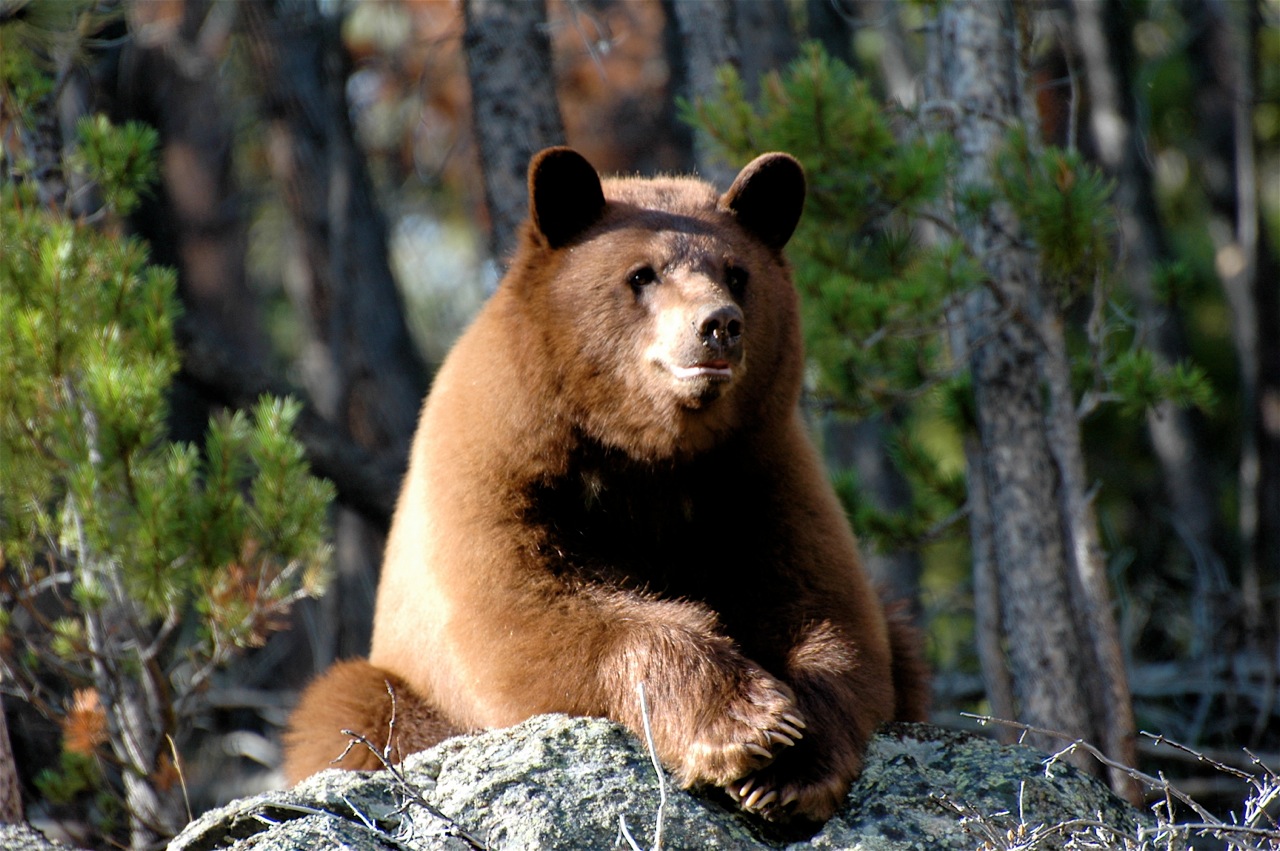
And organizations he supports. His images of wildlife have graced publications for the Denver Zoo as well as Rocky Mountain National Park (http://rockymountainnationalpark.com/ . One particularly popular one shows a female bear (a bearette?) at her ease on the edge of the forest. It’s featured on the front of the current membership brochure for the Rocky Mountain Nature Association (http://www.rmna.org//rmna.cfm), the park’s support group.

Professional photographers would kill for the visibility that Marty’s gotten for this piece, which resulted partly from sheer coincidence. Early one morning in May 2009, he was driving through the Park when the bear (http://coloradoblackbears.com/) ran across the road. It was the first he’d since in all his years of visits, so he stopped. She headed into the woods, then came out into a clearing at the side of the road and lay down on a rock. Seizing his opportunity, he stood in the driver’s seat and took his shots through the sun roof.

Later, when he read a request from the group for interesting wildlife photos, he submitted his. And was met with skepticism. Some thought the bear wasn’t wild or had been posed. His story and the sequence of additional shots convinced the staff.

While the shot occurred serendipitously, Marty says, “Sometimes photography is luck, but you still need to know what you’re doing with the camera. And the more you know about the subject, the better off you are, too. . . .One thing I try to do is look at something from a non-standard point of view.”

He continues, “I always enjoyed taking pictures.” Retirement allows him more time at it as well as studying how to take better photos For him retirement has opened a new door into an opportunity to learn and explore life in a new way.

Battle of Sexes Moves to Books

books The battle of the sexes is fun, challenging, and never-ending. A recent combatant, perhaps fighting with a bent lance or a broken sword, is David Gilmour, a Canadian author and professor at the University of Toronto, who refuses to teach women authors. Despite Alice Munroe’s Noble Prize for literature (http://tinyurl.com/l6cvavl) and the presence of talents like Margaret Atwood (www.margaretatwood.ca), he feels there’s a lack of excellence in the majority gender.

He said he “teach[es] only the best” writers, which does not include women. “I say I don’t love women writers enough to teach them, if you want women writers go down the hall. What I teach is guys. Serious heterosexual guys.”

As a writer and book lover, searching for excellence myself, I’ve spent my life, book open on my lap, desk, table, under or over the covers, entranced and entertained and educated by volumes of all types. I never distinguished between male and female authors, perhaps because I was assured repeatedly by teachers that English uses “he” and “everyone” as general terms for BOTH sexes in the collective. So if someone says, “Every great writer uses his talents,” I take this to include men and women.

When a child and teen I tended toward male writers because their work seemed more complex and interesting to me. As I grew older, I veered more and more toward women. The distinction I see now is that women writers seem to be somewhat more interested in character and internal, psychological growth, than many male writers.

I do admit I feel some questioning, some slight resentment when a male author has a strong, central female character. Just because book reviewers, publications, editors have a bias for male writers and provide much more attention to them than to women. Although most readers and book buyers are women, those in charge (still strongly male) emphasize men.

Gilmour continues to try to explain his remarks, saying they were tossed over his shoulder while conducting another conversation in French and they were meant “jokingly.” Gilmour has a new novel out called Extraordinary, and in his apology, Gilmour notes that the book’s protagonist is a woman, and he hopes his apology will help smooth over any hard feelings.

My theory, having heard a remark at any number of seminars and conferences recently, is that “there’s no such thing as bad publicity.” Certainly Gilmour must be sincere when he says you must teach what you love. But perhaps he and his publisher quickly realized his public profile is strengthened by the controversy. That women, like me, who have never heard of him, now will read his new novel, if simply out of curiosity.

Unfortunately for him, his book will have to go on the bottom of my list, which, at last count, included 13 titles by women and 12 by men, not counting the 24 stacked up on a table, again, fairly evenly divided by gender. Some are even collections or co-authored by women and men. Imagine that.

To see The Atlantic’s take on the discussion, go to http://tinyurl.com/n93jpf6
To see some of the original interview, go to Hazlitt online, http://tinyurl.com/nqak86r
To see a follow-up interview on the topic, go to National Post online, http://tinyurl.com/n7s7rtv

Raise an Eyebrow–If You Can

eyebrowThe human face owes its expressiveness to muscles and features. Eyebrows certainly have their share in the mix. Raising one or two eyebrows can indicate surprise, shock, superiority, doubt or disapproval. Some people can raise a single eyebrow, and this skill allows them to increase both the strength and range of emotions. A prime example of the use of eyebrows is Mr. Spock on Star Trek, who was indeed played by a human actor although he was supposed to be an alien. He often accompanied his raised eyebrow(s) with the label “fascinating.”

Somehow we always seem to be able to assign the correct interpretation to the eyebrows’ action. But all these abilities depend upon having eyebrows to raise. I’ve lost most of mine due to a little-known side effect of menopause, which not all women get. On the plus side, I’ve also lost most of the hair all over my body (except my head, thankfully). But losing my eyebrows isn’t a picnic because I haven’t been able to find a suitable replacement.

I know I’m dwelling on a relatively minor drawback to my overall appearance. I placidly accepted my aging face and figured eyebrows aren’t that important. After all, my mother-in-law didn’t have any, having been a vigorous plucker in her youth; and. I have friends who are losing theirs.

Then one day an eight-year-old girl was looking at me and my older sister. She decided I was older than my sister, partly because I have gray hair, while my sister tints hers. But also because, “You don’t have any eyebrows.”

Well! If eyebrows make a difference to a child, I figured I’d better start drawing some on. So began my quest for eyebrow color. Brown, black, blonde, taupe, applied with hard pencil, soft pencil, eyeshadow powder, smeared with a tiny brush, blotted with a tissue, tapped with my pinky finger. Arched, drawn at a straight slant, thick, thin, blended colors. Nothing looked natural. I finally decided the fault lies in the hue. Makeup experts evidently figure all women want dark brows, for that’s all they sell.

To me, dark eyebrows look threatening. They certainly overwhelm the rest of my face. I don’t want to scare children with a glowering dense substitute for regular eyebrows on my forehead. But I DO need eyebrows. After all, how else can I condescend to snippy eight-year-olds? So now I’m waiting patiently for someone to create eyebrow pencils in a range of grays to match the rest of my hair.

A Story Told

“To be a person is to have a story to tell.” —Isak Dinesen

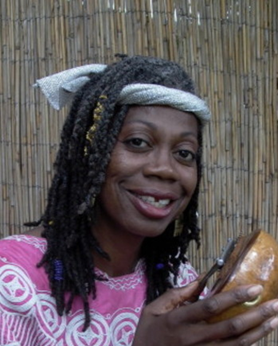
Opalanga Opalanga Pugh was an ordinary person with an extraordinary life, much of which she created and directed herself. Born in Denver, Colorado, in 1952, when people of color struggled against discrimination and limitations on their life choices, by 1972 she’d renamed herself after her Nigerian ancestors and begun her mission of storytelling.

Over six feet tall, chocolate brown, she carried herself like an empress. The gap between her front teeth, something that orthodontists would have wanted to correct, became a point of pride. In Africa the gap was associated with truth tellers.

That she was, but she couched the truth in stories, complemented by music and movement—from native peoples, from American culture, wherever a tale spoke to her. I once saw her speak to a group of some 75 women, mostly white and older. By the end of her presentation she was leading a line of all of us up and down the halls, around the rooms, in a joyous, joint celebration.

She said, “Who I am as a storyteller is one who is committed to the healing, the empowerment, and celebration of the human spirit. . .a Keeper of the Culture, a bridge-mother.” Known as a “griot,” a term and its variations used in West Africa for “storyteller,” she told her stories in ways that all peoples could understand and relate to.

She wasn’t with us long enough. She passed away in 2010 after a lengthy struggle, surrounded by close friends and family who had formed a network of support, provided day and night. Now those people have published, “When a Griot Dies,” a small book about her life, her journey, her spirit. Proceeds from its sale ($22 a copy) support the Opalanga Legacy Project, scholarships for all sorts of artists, keepers of the culture who honor her values.

“The universe is made of stories, not atoms.”—Muriel Rukeyser

For information on Opalanga, visit http://www.caringbridge.org/visit/opalanga
For information on “When a Griot Dies” or the Opalanga Legacy Project, contact Black Swan Books, opalangabooks@gmail.com ~ 303-366-4836

Tea for Two. . .or One

tea cup I love tea in china teacups. It captures all kinds of cultural and historic overtones—the ladies of Jane Austen’s era exchanging tidbits of gossip along with spoons of sugar, the velvet-covered steel of women’s influence in days gone by, distinctive and very feminine patterns of flowers and swoops and gold tracings.

I’m not sure why. Certainly my family background didn’t lend itself to gentility. On both sides my ancestors were workers, tillers of the soil, hammerers of nails, sellers of dry goods. Whether they even had time to slurp a refined saucer (yes, tea used to be drunk from a saucer, especially if hot), I doubt.

Tea in a china cup is different from a mug of tea or a glass of iced tea. It encourages lingering over, especially with friends. Confidences to be shared, trusts to be built. If I’m alone, it signals relaxation and thoughtfulness, qualities I’ve learned to value as I matured.

I’m guessing if we could get political leaders to sit down over a cuppa, our talks about disarmament and the economy would progress much faster. How can someone think angry thoughts while sipping the fragrant yet simple taste of tea.

So put on the kettle, find your favorite type of drink, put your feet up, and savor. Tea anyone?