About Bonnie McCune

Bonnie is a Denver-based author whose interest in writing led to her career in nonprofits doing public and community relations and marketing. She’s worked for libraries, directed a small arts organization and managed Denver's beautification program. Simultaneously, she’s been a free lance writer with publications in local, regional, and specialty publications for news and features. Her main interest now is fiction writing, and her pieces have won several awards.

I’d Tip My Wig to You, But I Haven’t Got a Wig

eliseMore and more people seem to be wearing hairpieces or wigs. Or maybe more and more people are wearing poorly made wigs. Walking out of a building today, I spotted a man with an obvious hairpiece. The piece was longish, all the same length (like a Dutch boy bob), and dark; but I spotted gray hair underneath where the hairpiece tilted a bit. I know other people with wigs obvious to the passerby. These folks must feel the accessory improves their looks.

But I wonder why someone would go to the trouble of buying a hairpiece that’s ill-shaped, poorly fitted, and whose color is at odds with the hard-earned traceries of time on the their faces.

Must be the wide-spread belief that gray or white hair makes you look older. Are wig-wearers so fearful of growing old—or looking old—that they’ll do anything to avoid it? Then why not dye it? Eleven percent of men and 55% of women color their hair, and you can be sure they’re not choosing gray.

Another option for changing styles are hair extensions, favored by public figures like Britney Spears, and not infrequently bedraggled or limp, and their close cousins, hair weaves. These usually are selected for the “beauty” they supposedly convey on the wearer.

Of course, there are lots of reasons to wear wigs that seem more legitimate than mere appearance: religious, health, diseases. But still the wearers are wearing wigs because they can’t or won’t tolerate nature’s dictates.

I have sufficient reason to participate. A young friend of mine guessed my age to be greater than my older sister’s, partly because my hair’s gray. But excuse me from the group. If I were really intent on fighting time, I’d do something about my hair; but I’m too lazy and too cheap and too devoted to simple comfort.

Not that there’s anything wrong with wearing artificial locks or coloring hair. Humanity has been doing it for millennia. If you have an inclination in that direction, go for it. However, I come down on the side of Chris Rock, whose documentary film “Good Hair” is a close look at black culture and the influence of society on young African-American girls. Natural hair is popularly believed to be unattractive, but Chris feels, and I agree, that natural hair tends to be a healthier, easier, more self-confident choice.

Plus, unlike wigs, natural hair won’t slip down over your forehead.
How to Get Organized and Disorganized

santa_lista
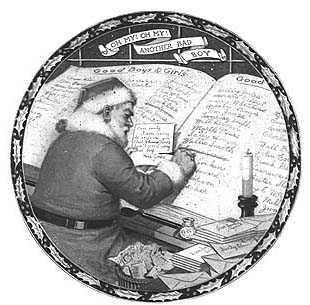
I’ve been a list-maker since childhood, and the holidays reinforce that character trait. Lists of gifts to give people, tasks to be accomplished, Christmas card recipients, presents I might like. But I’m beginning to realize that lists don’t necessarily make me more efficient. Rather, they force me to feel guilty. I’ve never been successful in crossing off every item on a list. In fact, the to-do’s seem to increase faster than the now-dones.

When I had a regular full-time job, my lists covered pages. I usually had one sheet per major project with sub- and sub-sub headings. Then, of course, I had the lists for home duties and the ones for other activities and writing. I experimented with keeping lists on paper, on a Palm Pilot when I still had one, on computer. Lists in various colors depending on type of task or in specially constructed tables and addenda to tables.

Since I stopped working for anyone other than myself, my lists have shrunk. But they still exist. Right now, I have four lists in my bag:
1. Items to learn about so I can use my tablet better.
2. Very old things I’m researching about publications or major household needs like photographing home valuables for insurance purposes.
3. Immediate needs, like finding a furnace maintenance business.
4. Kind of in between long- and short-term chores, like update my website and get the venetian blinds cleaned.

But then there are the immediate, don’t-forget-these-under-any-circumstances, such as birthday cards. These appear in my pocket calendar. And lists for special projects—marketing my fiction and organizing a volunteer effort.

I think list-making helps me feel I’m creating order out of chaos. If an item or task appears on a list, I don’t worry about forgetting it, and I can tell myself I’ll get to it eventually. Which I don’t necessarily. Hence, the guilt.

No reason to feel guilty if I apply one condition. The trick to controlling lists? IF YOU WAIT LONG ENOUGH, MANY OF THOSE LITTLE NOTES TO YOURSELF ARE OUT OF DATE AND YOU CAN THROW THEM AWAY. An example. Over months, I tracked down a writer whose work I admire, intending to send her a message. However, she’s quite elderly. If I wait long enough, she’ll pass away, and I won’t need to get in touch with her! Another example—transplanting herbs at the end of summer. I waited until the first freeze, which destroyed the herbs, and I now can drop that item!

Try applying this technique to your own lists and see if it helps you control them.

Keeping My Balance, or the Strange Case of the Woman With a Toothbrush Lodged in Her Throat

balance
Who’s the woman on the street corner lifting her leg to the front, side, back? Some urban looney? The victim of a new disease? No, I’m working to keep my balance.

I’m familiar with the hundreds, thousands, of experts and organizations who freely offer advice about achieving balance between work and family, mental and physical activities, spiritual and carnal desires. Stressed out? You need balance. Overweight or in poor condition? You need balance.

But another kind of balance is commanding attention in my life. It’s plain old body balance. Not falling down or over. Avoiding stumbles that send me tumbling to the floor. Being able to carry a tray of goodies without spilling.

Zumba dance class brought this concern front and center. Twenty years ago I could kick above my head without a thought, and a series of leg lifts like a Rockette was part of my routine. Then I realized that certain moves in Zumba routines are threatening me with disaster. These all relate to balance. Several quick thrusts alternating right and left limbs, even simply standing on one leg for a short period of time makes me shaky. Tremors run across my entire body, and my eyes cross as I try to remain vertical and stable. So I’m seeking ways to improve my balance.

Cars and pedestrians who pass me on my walks stare when they see me at a red light, for I’m exercising. Sometimes I practice when I’m stuck in line at the grocery store or post office. My latest effort, after reading advice from a 99year-old athlete, is to balance on one foot while I’m brushing my teeth. This is a true challenge, and I do worry my husband may find me one day with the electric toothbrush firmly lodged, but still vibrating, deep down my throat.

Another article with a trainer at the Y provided tips complete with photos in the Denver Post that I’ve tried to implement gradually. Start small with only a few inches of foot raising. Then add small weights or a ball to the routine. The pinnacle is perching on a stool or bar while holding barbells over your head.

I’ve been practicing semi-religiously for about three months with little improvement in sight. I’m getting so worried about losing my balance and injuring myself that it might be time to address the balances in my life concerning stress and worry. Once I do that, I’ll build up the courage to attempt the most challenging exercise: the half-ball, one-leg effort or Bosu ball. Just in case someday I have to traverse a road or hall with a surface constructed of globes, or I decide to join Cirque do Soleil.

Lessons from Sin City

lasvegas Las Vegas (Nevada) prides itself on its nickname of “Sin City.” I’d never been there for more than an hour or two until I visited recently and decided it definitely deserves its reputation. While I didn’t sample any illegal activities as far as I know, I did spot people dressed—or undressed—in close to nothing, lots of alcohol flowing, gambling and flashing lights, gyrating dancers, obscenities, people under the influence of whatever. Most of these fall under the classification of “sins” by American standards, especially if they’re extreme.

I also spotted the homeless begging for a handout. People talented or otherwise trying to make a buck through some sort of skill—twisting straw into decorations, contorting themselves into strange shapes, stuffing themselves into a box, exposing pseudo-breasts or real ones, dressed in costumes for photo opps. The dissonance between the amount of money being wasted on useless activities, most of which seemed designed to appeal to the lowest common denominator of human indulgence, and the apparent LACK of support for the poor, disabled, or uneducated, disturbed me.

Or was I disturbed by the overt flaunting of what are labeled “sins?” Over the years, I’ve liked to think of myself as open-minded, nonjudgmental, and accepting of others. But my immediate visceral reaction was repugnance. I’m not religious. I don’t think people who “sin” are destined for hell. I think what is defined as acceptable behavior in one age or location easily can be unacceptable in another. However it doesn’t appear that many types of behavior are unacceptable nowadays, whether in Las Vegas or elsewhere, since we appear to be intent on pandering to whatever self-indulgence we favor, whether that’s gluttony or gambling.

Still, what’s the difference between gambling away every spare penny or pampering ourselves with a day in a spa? Stripping to the buff in a public area or writing rude comments on Face Book and blogs? In each case, the first example may be a “sin,” while the second might be simply excessive. Passing laws doesn’t stop activities. Still, permitting them doesn’t seem to eliminate very bad practices such as violence and theft.

I wondered why I had such a major negative reaction to the Sin part of Sin City. Are there lingering remnants of my Christian, middle class upbringing? Am I jealous because there’s no way this body and face could turn a dime in this fashion? Am I evincing regret because I didn’t indulge in this type of behavior while I the time, money and opportunity?

Or are my objections valid? Are we fiddling while Rome burns? Are these behaviors indicators that our society is going to extremes, and people lack good judgment, pride, and standards?

Unlike many, I left Las Vegas with my bank account and dignity intact. But I won the jackpot because the questions my trip raised in my mind, even without answers, are forcing me to learn more about myself.

“The Good Parents” as Extraordinary Story

Stories can hold the sum of mankind’s knowledge, desire, and feelings. We learn better if our information comes in the form of tales. They needn’t be particularly dramatic or scary, but somehow they need to be human, connect to us through emotion.  For me, religions and philosophies are specialized stories, and hard sciences are palatable only if they are related in anecdotal fashion. A friend of mine believes I majored in psychology purely because the case studies resemble mini-tales. 

Everyone has his own story. It might be funny or frightening, instructive or entertaining. It might bore some and excite others. Telling a story well, so others can relate to it easily, is the duty of the writer. I have a long list of types of stories I don’t like: zombies, vampires, blood and gore, evil. Also not keen on most sports or tragedies. Don’t like offerings that include torture. Okay occasionally with deaths. I especially don’t like poorly written work. I know the definition of this varies according to the hearer/reader, but, as the untutored viewer said of art, “I know what I like.” 

I especially adore stories about ordinary people. Now that I think about it, I like stories with characters much like my friends—bright, curious, with kindly impulses, interested in what’s around them.  Like my friends, these characters hit highs and lows, have flaws and fortes. They face the challenge of surviving in a world that often is cruel and uncaring, nourishing within themselves  a careful consideration for their own well being and the same for others.. Examples—“Pride and Prejudice,” “The Things They Carried,” “White Teeth.” 

I’ve found a book that meets my qualifications and is a joy to read. “The Good Parents” by Joan London. Set in the author’s homeland of Australia, it features a teen-aged daughter seeking to reach adulthood through the time-honored fashion—an older man—along with the turmoil experienced by her mother and father, aging semi-hippies. There’s a mystery, in fact several mysteries: will the daughter meet a terrible fate and will a disreputable but powerful man in the mother’s past bring doom?

The beauty of this book, however, is neither plot nor action. Rather, the intricate weaving of the inner thoughts, the external impacts, the complex relationships, of the characters make you read faster and faster, to track the lives of people who somehow seem as close as dear friends or beloved relatives. The main characters as well as the secondary ones upon whom only a few pages may be expended are as faceted and radiant and entrancing as a diamond. Through this treatise on one family’s lives, I grew to appreciate my own more.

“The Good Parents” is truly an example of how ordinary people can have extraordinary lives.