Bonnie is a Denver-based author whose interest in writing led to her career in nonprofits doing public and community relations and marketing. She’s worked for libraries, directed a small arts organization and managed Denver's beautification program. Simultaneously, she’s been a free lance writer with publications in local, regional, and specialty publications for news and features. Her main interest now is fiction writing, and her pieces have won several awards.
Twenty-five years ago in 1993, a group of Colorado women, including me, launched a commemoration of the state’s woman suffrage. Colorado was the first state to institute votes for women, and it was accomplished by a popular vote. In other words, by men voting to endorse the move!
As I became involved with the project, I learned about the history of women’s political efforts. Seems to me in the West in general, women achieved status and power more easily than back East. Perhaps because the Homestead Act of 1862 allowed single, widowed, divorced, or deserted women to file for property. Perhaps because married women on homesteads and ranches had to assume men’s responsibilities and equal amounts of hard duties to keep the holdings afloat.
In any case women’s rights came more quickly out here. In Colorado, the movement was helped a great deal by the silver crisis of 1893. Silver was devalued and other economic brouhaha occurred. Then it wasn’t just kindly thoughts on the part of men; it was financial desperation. So much for lofty goals like equality of the sexes.
Regardless, the history of the women’s movement in the state is fascinating. The personalities, the strengths and weaknesses, the emotions stirred up make an exciting and educational account.
Each iteration of feminism brings its own perspective, extremists, battles, losses, draws, and wins. Cobble together your own interpretation of what was significant, who was a heroine, who a villain.. However, it’s useful to remember any time members of a group are lumped together as identical, the more scope for errors. In the 70s, women protestors were known as “bra burners” when, in fact, this wasn’t a wide-spread phenomena. The respected rumor-debunker Snopes says, During a demonstration by feminists at the 1968 Miss America pageant, some bras — along with numerous other items — were burned when a trash receptacle was briefly set alight.” This was the only occurrence of the symbolic action.
Another point: social change doesn’t occur overnight. Years ago, when my children were babies, my husband and I decided that family responsibilities were a benefit as well as a responsibility. We decided to alternate each of our stints at child and house care with employment to support us. This began as a one-year period but quickly extended to two, then five year rotations when we realized no one would hire us for any kind of decent wage if we constantly hopped in and out of jobs.
The first five years were my assignment. Because a stay-at-home mom wasn’t unusual, no one blinked an eye. However when we rotated, the response changed. Upon learning my husband was trying his hand at writing, one woman congratulated me on letting him be “the creative one,” never acknowledging my struggles at scribbling. Other responses included sly comments about “an alcohol problem,” “lack of job skills,” or just general “no ambition.”
None were true. The first step for our then-unusual transition was my husband’s. When the kids were very little, one day he offered to let me have an entire day a week to do whatever I wanted while he took care of house and children. I pulled out a piece of paper and toted up the number of hours I normally spent on my chores. When I realized the accumulative time was well over ten hours a day, seven days a week, while he was working eight hours a day, five days a week, I surrendered without a complaint.
So just as women’s right to vote in Colorado was approved by men, my personal voyage to women’s lib was launched and sustained by a man, my husband.
Is this often true of social change? It may be. Certainly the prohibition on slavery never would have occurred without the support of some white men. The
realization that children deserved protection from excessive labor and horrid conditions came from adults. If the #MeToo movement bears productive results, it will occur because people of all genders support it and come together in a spirit of good will.
* photo courtesy Denver Public Library Western History Dept.
For two weeks I’ve been searching for a piece of glass for a picture frame. I know I have one somewhere. I remember buying the frame years ago and not using it right away. I stored it on a closet shelf. Recently I broke a glass and started looking for its replacement. Nowhere.
Of course, between the last time I stumbled on the glass, probably digging around for another lost item, we moved. Naturally now it’s missing. Along with the other items I’ve misplaced during the move. These include some shoes, important instructions for equipment, one year’s tax returns, and a mixing bowl.
I’ve always prided myself on being organized. Other people link this characteristic with me, too. But I’m here to tell you the reason I’m organized is because I constantly and desperately am fighting chaos. I’m not an obsessive-compulsive; I’m just panicky. I restrict my messes to specific areas—a shelf here, a drawer there, the garage storage.
Other people’s chaos is so huge, they can’t control it. I see victims of hoarding disorder on television. Garbage rots, belongings seem to multiply on their own, clothing disintegrates, piles grow higher and higher until they collapse. Health and safety are threatened.
No one thinks his own hoarding is out of control. Many of us believe our neighbors or friends accumulations are. Some consider messes to be a sign of creativity, I suppose because it shows such variety, it must indicate lots of ideas.
Others say a cluttered desk is a sign of a cluttered mind. Someone, or several someones, including Einstein if you can believe a Google search, asked, “If a cluttered desk is a sign of a cluttered mind, of what, then, is an empty desk a sign?”
There is a real cost to clutter. We lose valued items in it. Research from Pixie, a tracker app for lost items, reveals that Americans spend an average total of 2.5 days a year looking for misplaced stuff. That’s nearly half a workweek we lose just searching for things.
Hope is in view. Advice abounds in how-to, from the Japanese expert who urges “joy” as the bottom line to advocates of discarding anything you don’t use at least every six months. You can also set your own goals such as one drawer a week, or encouraging your friends and neighbors to swoop in periodically to identify with colored tags the items they’d like to relieve you of.
Or pick a day, any day, and tell yourself you’ll start with your desk, groaning under stacks of papers. If you don’t have a particular date in mind, aim for “Clean off your desk day,” the second Monday of January. Then you’ll have a little spot of order in all your disorder. Perhaps it will grow. You can only hope.
Something always hurts. If not my knees, then my back. If not a tooth, then a muscle. Each day brings a new insight into the limitations of the human body.
What’s causing this testiness? Age? Do our bodies simply start breaking down? Yes, to some extent. But even more, I feel dogged by the sense time is speeding by and the physical symptoms serve as markers, reminders. Once you pass a milestone birthday, be it 40 or 45 or 50, you realize more years are behind you than ahead of you.
So I get impatient with incompetence, idiocy, and ageism. Example: the young woman on the jogging and biking trail with two dogs, occupying the entire width of the sidewalk, who, after I’d TRIED to alert her to my presence, called, “You could say excuse me.” Used to be, I wouldn’t have responded. Nowadays I do. Loudly, and I tack on a frank comment on her behavior.
Still nonsense like that is only the beginning. Even worse, seems as if it’s open season to bad mouth and mock older people. Ageism is the popular term. Since few comedians are comfortable belittling races or religions or social classes nowadays, denigrating older adults substitutes. I wouldn’t mind so much if the jibes were limited to actions over which people have choice and control. But all too often they’re simply physical traits no one can influence. Such as wrinkles or moving more slowly or failing to hear or see adequately, or simply looking old, meaning “ugly.”
Not fair. Not nice.Mean-spirited, rude, and deliberately hurtful. And duplicated not infrequently by the general public as an older adult is ignored in a store or restaurant. Or by a pedestrian who nearly knocks you down on the sidewalk. Or a relative who heaves a great sigh at another recitation of an old memory.
Yes, I can be grouchy, grumpy, or any other similar term you choose. I’ll continue to battle the actual impactof aging by getting involved in various physical and mental activities. And for the less obvious psychological repercussions, I’ll wear my “such a nasty woman” t-shirt with as adequate warning.
There was a time after my kids reached legal adulthood when I greeted Halloween with a sigh of relief. No longer did I need to hustle creative juices, time, and money to try to outdo other moms and grandmas in costuming little ones, but also I was relieved from guard duty over teen hijinks like t.p.ing neighbors’ houses or underage drinking. In those days, my eyes used to achieve maximum blurriness when I paced the floor and watched the clock in trepidation.
But after that early epoch, as I attempted to sink into a cathartic calm of middle age, an adventurous friend appeared on my doorstep one October 31. I forget how old she and I were, but I’m sure in the range of 40. Neither of us had been invited to an adult Halloween party, the type featuring hard liquor and harder attempts by married folks to connect with a “swinging” temporary partner. She, however, was rarin’ to go out on monkey business.
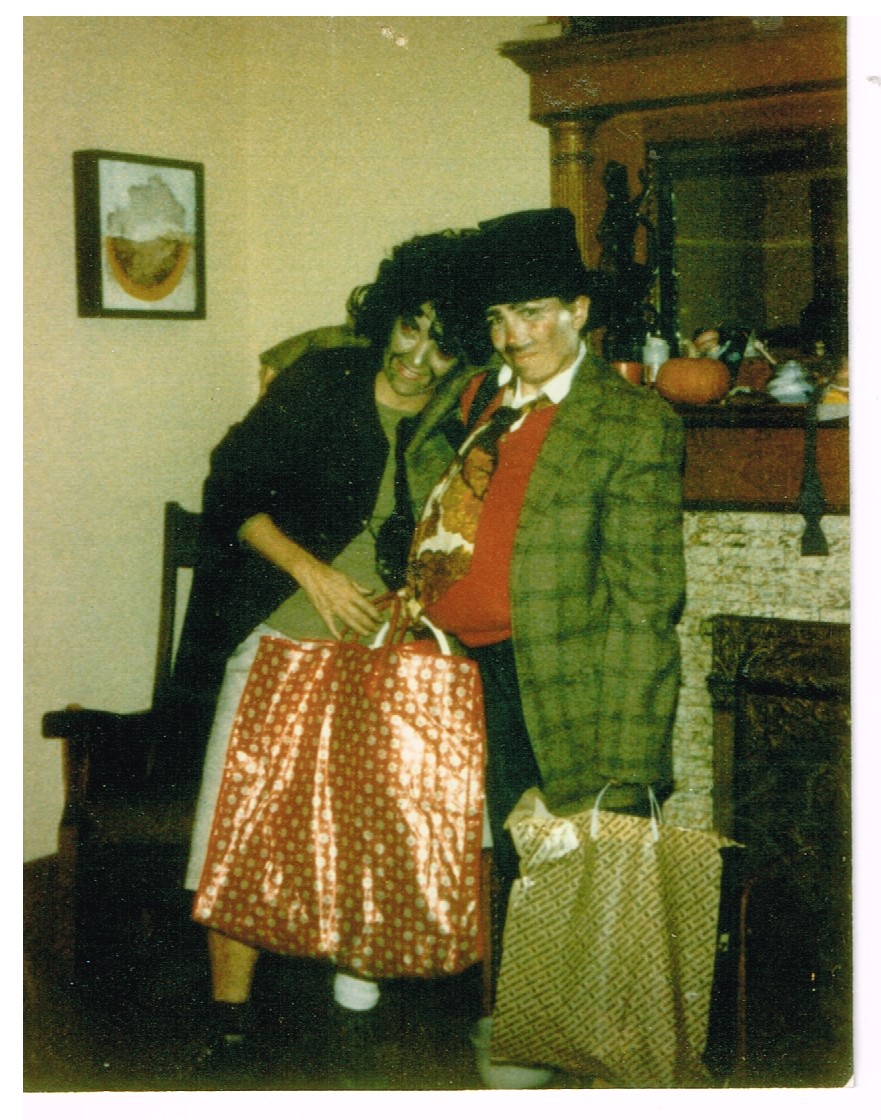
Her idea—cobble together a costume out of whatever we could lay our hands on and try to pass ourselves off as children to our friends and neighbors. What astonishment we’d create when we revealed ourselves.
Since we both are short, barely breaking five feet, we weren’t much bigger than the early teen rabble-rousers we saw coming to the door during the evening’s later hours. She’d supplied herself with charcoal and eyeshadow so we could disguise our faces as well as dressing herself in a wig, and shabby old clothes she’d retrieved from discards in the closet. I raided my husband’s stock of outdated outfits, we smudged coloring on our jaws like five o’clock shadow and around our eyes like weary laborers, and off we went.
In front of the stop, we paused to plot. We agreed to slump and hunch a bit and pull our hats down. We figured we resembled 13-year-old boys dressed as bums. I still doubted we’d fool anyone, but I beat on the door, mumbled “Trick or treat,” and held out a bag. She did the same, but she disguised her voice better than I.
Our friend, who was also a neighbor and whom we saw almost every day, didn’t bat an eye. She hauled out the candy, loaded our bags (it was late in the evening, so she had a lot to get rid of), chatted a bit about Halloween mischief, and escorted us to the exit. That’s when we revealed our true persona. We’d buffaloed her completely.Halloween
And so it went at each of the half-dozen or so homes we visited. We hoodwinked every single person, and we gathered a load of sweets that I did not share with my family later. I’d worked too hard for my booty.
In addition to being a fun anecdote for my personal history, our little adventure convinced me that people see what they want to see, not what’s really there. I don’t think our costumes and makeup were particularly artistic, but not a soul really looked at US.
Since that time I’m never surprised if a homeowner shoots his own child during the night, thinking he’s battling a thief; or if a policeman guns down a dark fuzzy character figuring he’s stopping a murderer; or if a hit-and-run driver flees the scene assuming he’s collided with a squirrel or cardboard box.
In these days of “rush-to-judgment,” whether that’s the perpetrator responsible for the violence or the ever-disapproving public judging it, it’s waaaay too easy to make accusations or even take action based on unfounded assumptions. Let’s think a little before we do so. A teacher once told me, “Never assume, it makes an ass of u and me.” Something to consider.
In the here and now, time confuses me. It seems to creep by in the here-and-now, while the past flies in my memory.
A trip to Pennsylvania pushed this thought to my mind. There the back roads meander through well cultivated fields while tidy historic homes and moderate suburban housing developments break the monotony of greenery. If I recall, the Pennsylvania landscape, the environment, is the product of only about 300 years of man’s presence.
Then I remember I’m connected to five generations myself. My grandfather was born in 1897, my younger grandson in 2011. That’s more than a century, the equivalent of five sets of generations in this amount of time. So a relatively small number of generations separate me from the beginnings of contemporary civilization in this country. Time doesn’t just fly, it zooms.
The strange juxtaposition in my thoughts comes from thinking how I’ve missed my opportunity to gain information about my family.
I knew my father had lots of stories because he told us some of them. One frequent narration concerned his hanging on to backs of trucks to joy-ride when only three. What I don’t know, because I never asked, were details like: was he with a brother? Did his parents find out? Was he punished?. Most likely. I think perhaps he was very like my second grandson. Always ready to try something risky, always laughing with a full body guffaw. I remember my dad this way in my childhood but not after I grew up. Then he seemed gruff, even angry. After seven children, a divorce, the rebellions of those children, the failure of a business, he surely had enough reasons to be frustrated and angry. But why didn’t I ask more questions when he was still here? Now I never can capture these details or get to know him as a person, not a father. This is my first lesson learned too late in life.
Then I think about our country. Three hundred years ago, pristine waters and air, burgeoning plants and animal life crowded the continent. Of course if we’d halted any development at that stage, I wouldn’t be here. But comparing my idyllic view of the past with the crowded, frantic, even destructive landscape I see now, I shudder for our future.
In one area of Pennsylvania, a pipeline has been proposed to carry high-pressure natural gas. This development would go near lots of residents and businesses. According to a homeowner, there are no methods available to individuals or local government to question the proposal or insist on safeguards. Once the pipeline’s in place, like any other creation, it might be destroyed or explode, endangering locals.
This isn’t a fantasy. In Colorado, just last year a house explosion killed two. This was caused by odorless gas seeping from a cut-off underground pipeline into the house through French drains and a sump pit. The pipeline was too close and not regulated enough to prevent the accident and subsequent needless deaths. New legislation will, I hope, rectify the situation. Too little, too late.
Is this the case in Pennsylvania example, too? I don’t know. All I know is that some opportunities don’t reoccur. Over and over and over we’re told development and growth are “progress.” We’re told we must sacrifice landscape, native flora and fauna, even human safety for improvement. In less than 250 years, since the establishment of the U.S., we have managed to make human presence felt everywhere
Is continuing in this manner wise? Will this become another lesson learned too late in life?



 Bonnie McCune, author